Insights · Education & AI
Shape the Technology: What a Physics Classroom Taught Me About Building AI That Teaches
For twenty years we adapted technology to schooling, and learning outcomes stayed flat. The harder path is to shape the technology so that it develops understanding, the way a good teacher does. Here is what that looks like from inside a classroom, and why it might matter most for the children who have had the least.
For two decades we put educational technology into classrooms at scale, and the learning outcomes barely moved.1 That is not a small disappointment. It is the first fact anyone serious about AI in education has to explain before promising anything new.
Part of the explanation, after eleven years teaching physics, is that most educational technology was built to deliver answers faster. We took whatever the technology could do and fit it to the shape of a lesson. That worked while the bottleneck was access to information. It stops working the moment the technology can produce any answer, on any topic, instantly. When a machine will hand a student a finished solution in three seconds, a faster route to the answer is the last thing that student needs.
The deeper reason sits in the learner. Learning requires cognitive effort, the kind that feels like strain. The digital world these children grow up in trains the opposite reflex. It delivers fast, low-cost reward, and it quietly erodes their tolerance for effort. There is now evidence that heavy reliance on AI tools reduces the cognitive effort people invest and weakens critical thinking, and that the effect is strongest among the young.23 Many of my students now expect to learn without the work of learning, and they do not even notice the contradiction. That, more than any missing feature, is what a new tool has to reckon with.
So I did two things. I changed how I assess my students, so the effort has to stay with them and cannot be handed to a chatbot. And I began building the AI tools my students use, so that those tools teach instead of tell. The first is me adapting to the technology. The second is me shaping it, at the small scale a teacher can control. This essay is about the second, because it is the part that could travel.
Before the examples, the reason I think this matters far beyond my classroom. My students are the hard case: saturated, impatient, allergic to strain. But for children who did not grow up inside this flood of devices, the same technology points the other way. An AI with deep knowledge, endless patience, and the discipline to lead a learner through questions rather than answers could do the most good precisely for the children who have had the least access to a good teacher. The largest gains are not in my well-resourced classroom. They are there.
Here is what shaping the technology has looked like in practice. Three tools I built and run with real teenagers, none of them finished, all of them evidence.
Students pull, they do not receive
The first is a classroom game I built called Physics Courtroom. Students join a session with a short code and step into a forensic-style case: a crash, a fall, a disputed measurement. Nothing is handed to them. To make progress they have to decide what evidence they need and request it from an AI forensic lab director. Then they defend their physics before an AI judge and prosecutor that push back on weak reasoning and reward strong reasoning.
The design choice that matters is the direction of effort. The student pulls. The investigation is driven by their own questions, not by a pre-packaged data dump. They can photograph their handwritten work and have it read and assessed. Because the courtroom characters respond differently every time, students learn by arguing, defending, and revising rather than by reading. The drama is not decoration. It is what keeps a fifteen-year-old curious enough to keep going. It is under active development, and it now runs in English, Arabic, Russian, and Hebrew.
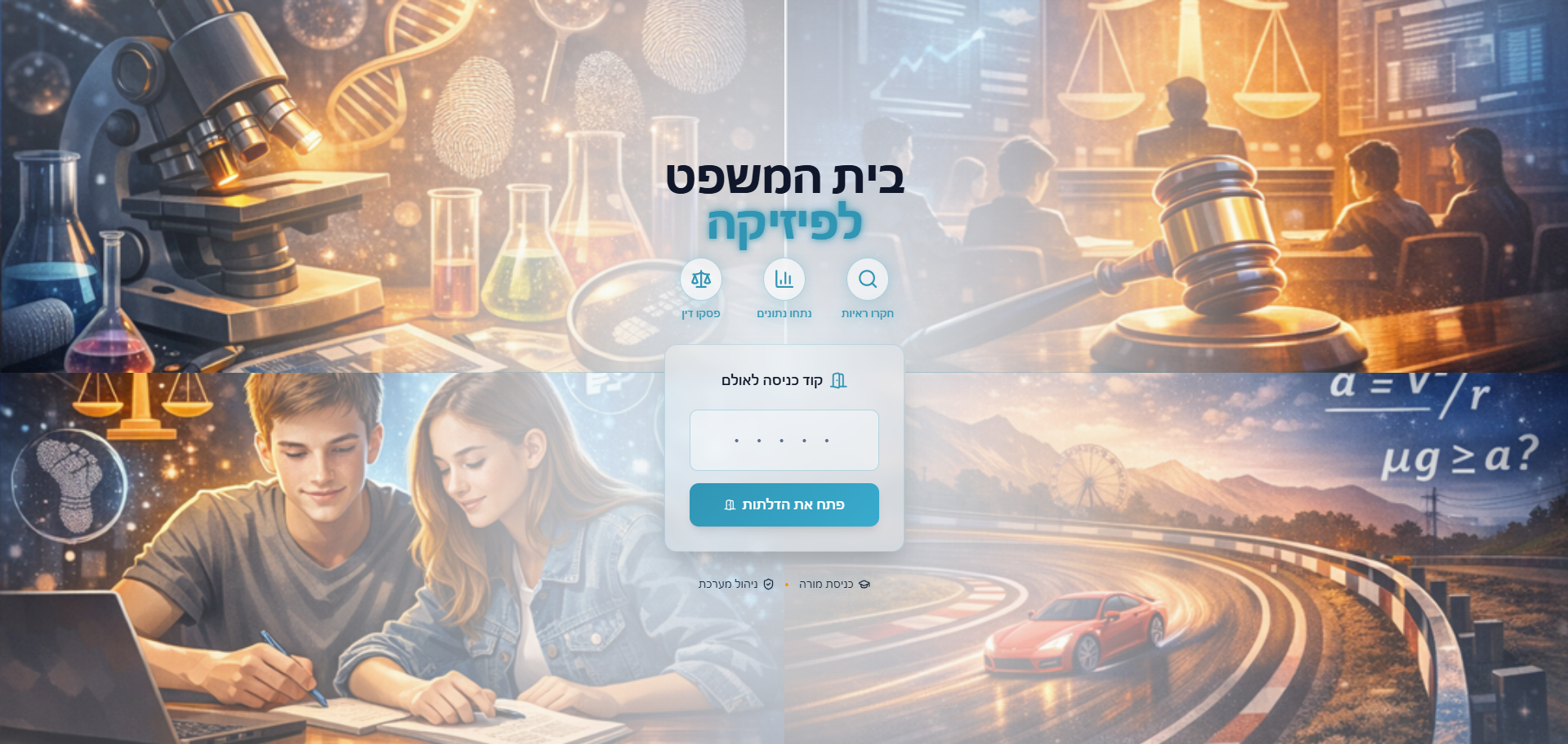
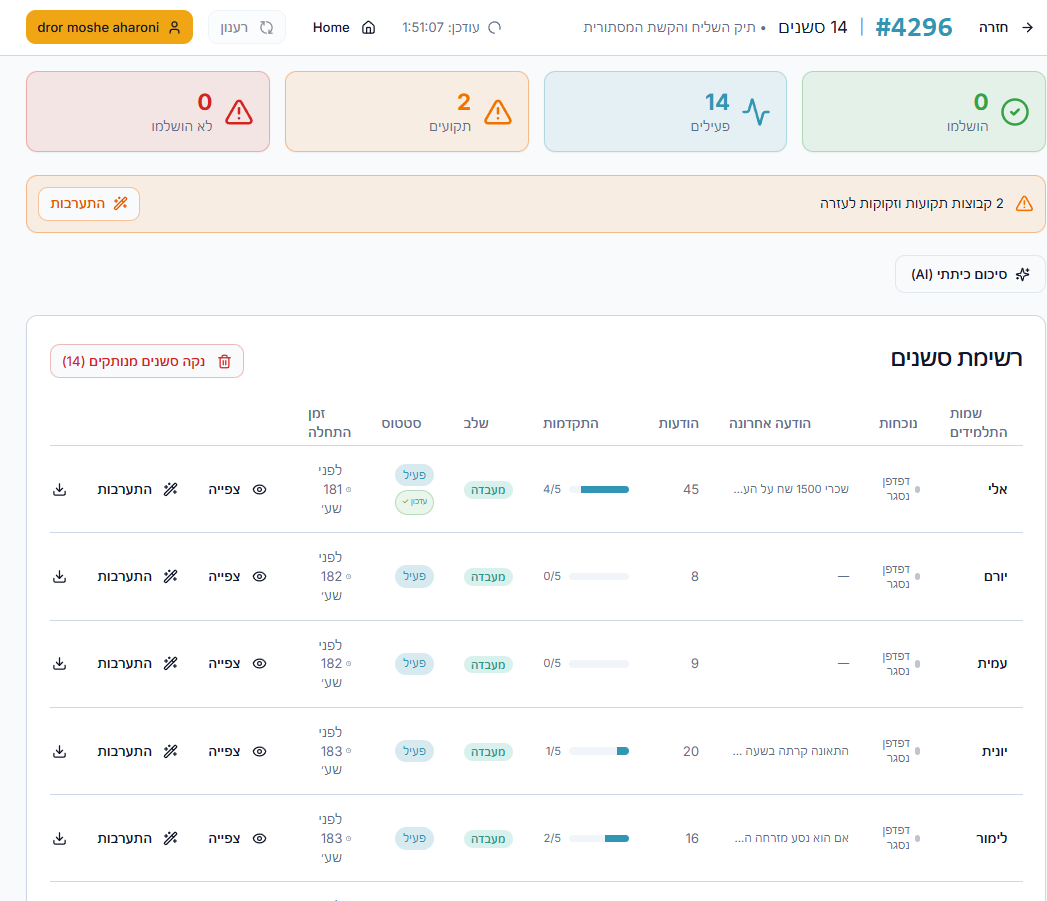
A real classroom trace: a student session transcript from the case "The Courier and the Mysterious Rainbow" — lab phase, where the student has to pull evidence rather than receive it. Download the sample session transcript (PDF).
A tutor that teaches the way I would
The second is a Socratic tutor I call Physics Dror. It is built as a digital twin of how I teach. It never hands over the answer. It draws the student into the reasoning and leads them through a problem with questions, the way I would if I were sitting beside them. I built it drawing on recent research showing that an AI agent, interviewed about a person, can reproduce that person's judgments with surprising fidelity,5 and on methods for structured, multi-step interviewing that keep a conversation on a deliberate path instead of letting it drift.6
I have run it with my students for two and a half years. They tell me they reach for it most when they are studying for exams, and they come back to me having argued with it and worked something out for themselves rather than having copied an answer. That is the difference I am trying to build for.
A narrower version makes the same point sharply: a tutor built around a single classic problem, a ball dropped from the mast of a moving ship, that only ever asks the student to predict, observe, and explain. One problem, deep. A small tool built to make a student reason beats a vast tool that answers everything.
Grade the process, and put friction back on purpose
The third is a final project in optics where students build their own interactive simulation using AI, with no prior coding required. This is the third year I have given it, and I rebuild it each year around whatever AI tools are current the month I teach it. What makes it work is not the tool. It is the method around it.
Seventy percent of the grade is the process, not the finished product. At each milestone, students must run their work through an AI mentor I built that gives feedback and sends them back to revise, and they cannot submit without showing that conversation. The grading runs against instinct. A team that claims everything worked perfectly, that they hit no walls, loses points. A team that hit a real problem, the code crashed, the model misled them, and shows how they investigated and solved it, earns a bonus.
I do that on purpose. Productive struggle is not a flaw in learning to be smoothed away by a helpful assistant.4 It is the thing itself. An AI that removes all friction removes the learning with it. So I designed the friction back in, and I instrument it, so the effort is visible and rewarded.
What this means at scale
None of these are finished products, and I am not claiming they are ready to run in 150 countries tomorrow. What they offer is a handful of design criteria that travel across tools, subjects, and languages.
Make the student pull, so the learner has to ask, decide, and defend rather than receive. Instrument the process, not just access, and measure the struggle and the reasoning rather than the fact that a child touched a device. Keep the teacher central, as the author and the coach, never a bystander to an app. And use friction deliberately, because the goal is not a frictionless experience but a productive one.
I did not arrive at these in isolation, and it reassures me that they line up with how serious institutions now judge educational technology. UNICEF's EdTech for Good framework asks whether a tool is safe, whether it has real impact on learning, whether it is designed for how children actually think, whether it can reach everyone, and whether it leaves no one behind.7 Those are the same questions, from the evaluation side, that my classroom keeps forcing on me from the design side.
I am also not the first to try this at scale. Estonia's national AI Leap program gives its students an app that, in its own description, does not hand over answers but acts more like a teacher, helping students plan and reach their own conclusions, and its effect on learning is being measured by researchers at the University of Tartu.8 A whole country is testing the bet that AI should guide rather than answer. That is the same bet I am making in one classroom, and it is why I think the design criteria matter more than any single tool.
There is one frontier where I am the student, not the teacher: making designs like these run in low-connectivity and low-resource settings, on small or offline models, for children whose schooling is disrupted or denied. Small open models are getting good enough to matter here. Google's Gemma family now runs offline on a phone and covers more than a hundred languages,9 and people are already building offline tutors on it.10 Whether a patient, Socratic tutor can run well on a device in a classroom with no reliable internet is exactly the question I want to work on, alongside people who know those settings far better than I do.
This is a field report, not a finished framework. The interesting work now is turning these instincts into shared design criteria that large systems can actually adopt. If that is a conversation you are having too, I would like to be in it.
Notes and references
- OECD (2015). Students, Computers and Learning: Making the Connection. OECD Publishing. doi.org/10.1787/9789264239555-en
- Lee, H.-P., et al. (2025). The Impact of Generative AI on Critical Thinking: Self-Reported Reductions in Cognitive Effort and Confidence Effects From a Survey of Knowledge Workers. Proceedings of CHI 2025 (Microsoft Research and Carnegie Mellon University). doi.org/10.1145/3706598.3713778
- Gerlich, M. (2025). AI Tools in Society: Impacts on Cognitive Offloading and the Future of Critical Thinking. Societies, 15(1), 6. doi.org/10.3390/soc15010006
- Kapur, M. (2008). Productive Failure. Cognition and Instruction, 26(3), 379-424. doi.org/10.1080/07370000802212669
- Park, J. S., et al. (2024). Generative Agent Simulations of 1,000 People. arXiv:2411.10109. arxiv.org/abs/2411.10109
- Bi, G., et al. (2025). MAGI: Multi-Agent Guided Interview for Psychiatric Assessment. Findings of the Association for Computational Linguistics: ACL 2025. aclanthology.org/2025.findings-acl.1278
- UNICEF. EdTech for Good: A Global Framework for Safe, Inclusive and Impactful EdTech. UNICEF Global Learning Innovation Hub. unicef.org/digitaleducation/edtech-for-good
- AI Leap (TI-Hüpe), Estonia's national AI education program. tihupe.ee/en
- Google. Gemma open models (on-device E2B and E4B sizes; trained across 140+ languages). ai.google.dev/gemma
- Google. See what builders are making with Gemma 4 (BetterSpeak, an offline AI English tutor built on Gemma). blog.google